“A record 8% of households with
minor children in the United States
are headed by a single father, up from just over 1% in 1960, according to a Pew Research
Center analysis of
Decennial Census and American Community Survey data.
The number of single father
households has increased about nine-fold since 1960, from less than 300,000 to
more than 2.6 million in 2011.1 In comparison, the number of single mother
households increased more than fourfold during that time period, up to 8.6 million
in 2011, from 1.9 million in 1960.
As a result, men make up a growing share of single parent householders.2 In
1960, about 14% of single parent households were headed by fathers, today
almost one-quarter (24%) are.”
When you look at the local data on family types with minor
children in the home, you find some interesting trends as well. Just like the
national data, we have seen a rise in the percent of families with minor
children being headed by single parents. Between 1970 and 2010, the percent of
families with children under the age of 18 who were headed by a single mom or
dad went from about 11% to 35% in Oneida
County, and in Herkimer County
it rose from 9% to about 34%. These are three to four fold increases in the percentage of families experiencing single
parenting.
 |
| Click to Enlarge Herkimer County Data |
|
 |
| Click to Enlarge Oneida County Data |
|
Obviously these increases correspond to decreases in the
percentage of families with children under the age of 18 present that are
headed by two parents. While in 1970 around 90% of the families with minor
children were two parent families, by 2010 this number had dropped to below 65%
in both counties.
I also looked at the median family incomes of these various
"families with minor children present" configurations by examining the three year estimates from the American
Communities Survey data for 2011. Not surprisingly married couple families with minor children at home make
considerably more than their single parent compatriots.
In Herkimer County
the median family income for a two parent family with minor children present is
slightly above $65,000 a year; in Oneida
County it was over
$77,000 annually. In comparison, female headed families with minor children
present only had median incomes of about $28,000 in Herkimer
County and $23,000 in Oneida County.
 |
| Click to Enlarge |
Interestingly, families with minor children that were headed
by single males had median incomes that were more than 40% higher than those
headed by single females. Single fathers with minor children at home had median
incomes of roughly $39,000 in Herkimer
County – 42% higher than
their female counterparts. In Oneida
County, single dad
families had a median income of around $33,000, or 45% higher than female
headed families with minor children at home. Having only a single adult wage
earner clearly makes it more difficult for single parent families to make ends
meet regardless of the gender of the parent.
This was clearly indicated when I looked at poverty data for
each type of "family with minor children at home" in our region. Examining the combined data of Herkimer and Oneida Counties,
and focusing on families in poverty, we find that for all three family types
(married couples, single female and single male headed families) the data shows
the presence of minor children in the home is exceeding common among those in poverty. In other words it is very common in our region for families struggling with poverty to have young children at home.
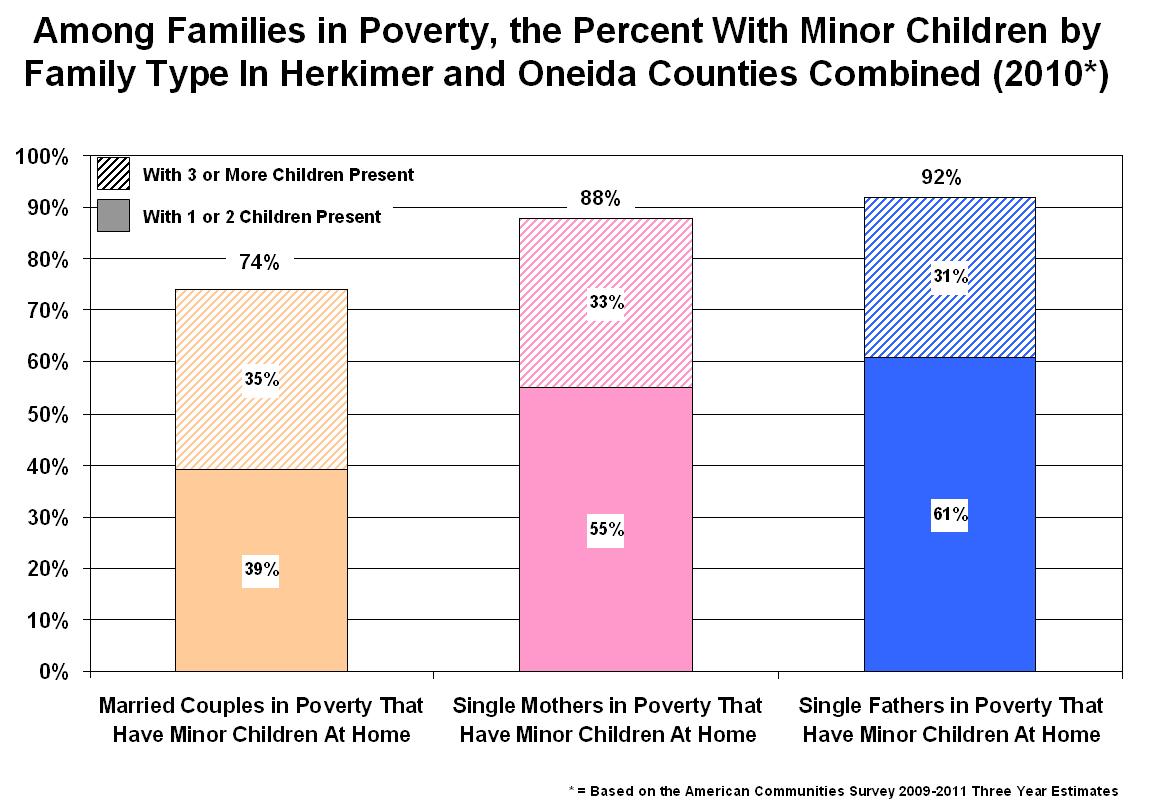
Among married couples in poverty, for example, 74% of all
such families have 1 or more minor children at home. As many as a third of married couples in
poverty (35%) have 3 or more children living in the household.
 |
| Click to Enlarge |
In comparison, we find a larger percentage of single parent
families in poverty having minor children living in the household. About 88% of all single-mom
families in poverty have children under the age of 18 living at home, and 92%
of all single-dad families in poverty also have minor children in the
household. In both these cases about a third (33% and 31%, respectively) have
three or more children present.
So while our area has seen some similarity in the "rise" of single parenting, and specifically in terms of single father families, these families are still clearly struggling when ti comes to making ends meet.
 The Atlantic Magazine recently reviewed a new report by PEW Research which provides a portrait of some very significant demographic and cultural shifts in the United States. The report is
filled with fascinating details about who we are as Americans, what we
believe, and how both of those things have changed over the last several
decades.
The Atlantic Magazine recently reviewed a new report by PEW Research which provides a portrait of some very significant demographic and cultural shifts in the United States. The report is
filled with fascinating details about who we are as Americans, what we
believe, and how both of those things have changed over the last several
decades.