Showing posts with label small businesses. Show all posts

Wednesday, September 16, 2015

New Census Web Tool Helps Business Owners Make Data Driven Decisions

 The U.S. Census Bureau released Census Business Builder: Small Business Edition, a new Web tool that allows business owners and entrepreneurs to easily navigate and use key demographic and economic data to help guide their research into opening a new business or adding to an existing one.
CLICK TO ENLARGE
The Census Business Builder was developed with user-centered design at its core and incorporated feedback from customers and stakeholders, including small business owners, trade associations and other government agencies.
The tool combines data from the American Community Survey, the economic census, County Business Patterns and other economic surveys to provide a complete business profile of an area. Business statistics include the number of establishments, employment, payroll and sales. American Community Survey statistics include population characteristics, economic characteristics and housing characteristics.
If you want to  go directly to the web tool, click here to launch the small business edition tool. Below is a sample screen shot for mapping the total consumer expenditures when dining out that might help a small business owner decide where they wanted to locate a new restaurant. Click the map to enlarge it.
CLICK TO ENLARGE

Tuesday, May 26, 2015

Regional Nonemployers: Measuring Self-Employed Businesses


The U.S. Census Bureau has released the 2013 Nonemployer Statistics on Thursday, May 21, 2015.
Most non-employers are self-employed individuals operating unincorporated businesses (known as sole proprietorships), which may or may not be the owner's principal source of income.

Nonemployer Statistics are an annual series that provides economic data for businesses that have no paid employees and are subject to federal income tax. The data consist of the number of businesses and total receipts by industry. Receipts includes gross receipts, sales, commissions, and income from trades and businesses, as reported on annual business income tax returns. Business income consists of all payments received for services rendered by nonemployer businesses, such as payments received as independent agents and contractors.
 
The data are accessible through the U.S. Census Bureau’s American FactFinder and the Nonemployer Statistics website. Below are some of the numbers as they apply to the region (Herkimer and Oneida Counties combined) from the Nonemployer statistics.


CLICK TO ENLARGE


CLICK TO ENLARGE

Thursday, October 2, 2014

Does Buying Local REALLY Matter?

A post at Demo Memo, a great site analyzing demographics data, looked at the issue of local businesses and the impact "buying local" has. As they asked the question, "Does buying local matter to economic well being?"

What they found was that this question is addressed in a Federal Reserve Bank of Atlanta analysis  of county level economic data for the 2000 to 2009 time period. Economist Anil Rupasingha examines the local share of employment by county and compares those numbers to real per capita income growth, employment growth, and poverty.

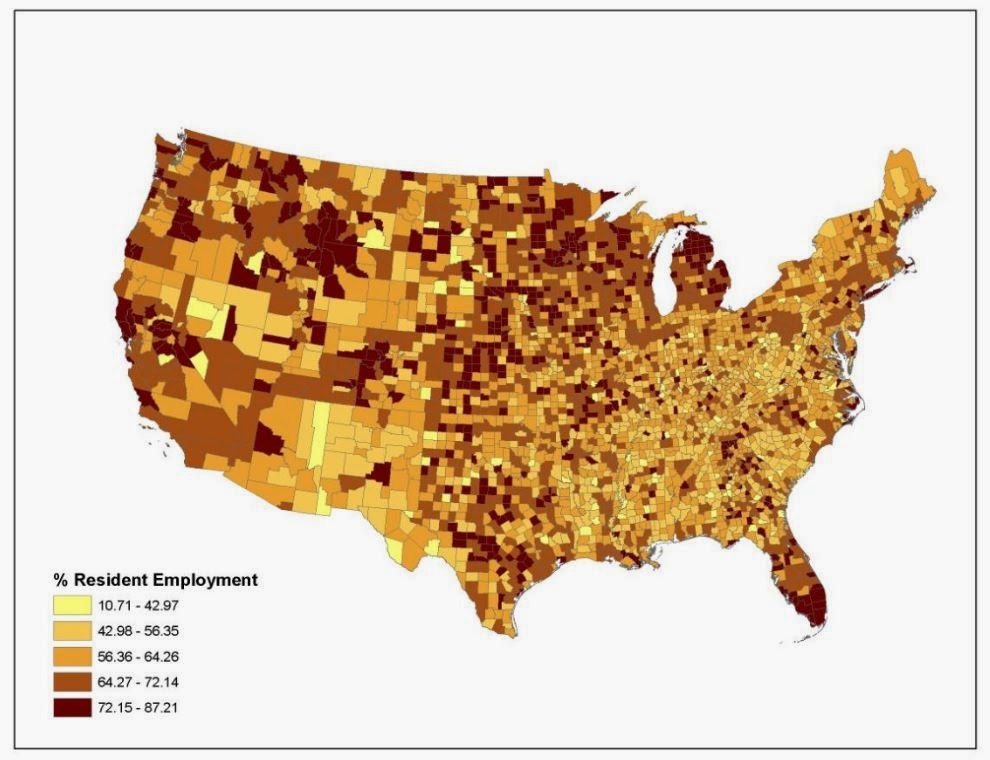
In most counties, employment in locally-owned businesses surpasses employment in "nonresident-owned" businesses. But the local share varies greatly by county, which you can see at a glance in the county-level maps included in the analysis. The share of employment in locally-owned businesses varies by county from 11 to 87 percent. The share of employment in nonresident-owned businesses varies by county from zero to 85 percent.

Percent of Residents Working in Locally Owned Businesses (2007)


Click to Enlarge


"Historically, the most popular local economic development approach was to attract businesses outside a particular municipality, state, or region," says Rupasingha. But theories about local economic development are changing, he says, and "economic development based on local entrepreneurship is increasingly gaining traction." Which approach is better?

Local is better. According to the study's results, the greater the local entrepreneurship, the greater the per capita income and employment growth and the lower the poverty. Also and interestingly, smaller local businesses have a greater effect on local economic performance than larger local businesses. "My results suggest that fostering smaller local businesses may be good local economic development policy," Rupasingha concludes.

Locally, businesses with less than 50 employees make up about 98% of companies in Herkimer county and 95% of those in Oneida County. There are more than 10,000 people who consider themselves "self employed" in the region ! So obviously small businesses play a big part of our local economy.

Thursday, June 13, 2013

How Important Are Small Businesses?

We often hear that small businesses are the engines of job creation in the United States. According to an article on Forbes.com their value and the role they play in our economy is sometimes underestimated because, they are in fact, small. But the truth is there’s nothing small about the impact they have on our economy. They cite a recent study by Entrepreneur Magazine that there are between 25 million and 27 million small businesses in the U.S. that account for 60 to 80 percent of all U.S. jobs. And, a recent study by Paychex, says that small businesses produce 13 times more patents that larger firms.

Those numbers may be a little high, at least compared to numbers derived from the Census Bureau.  The website Feefighters.com offers the following infographic that lays out the importance of small businesses (which typically means businesses with 500 or fewer employees) based on Census Bureau statistics.

Click to Enlarge

  Locally, small businesses make up nearly ALL of the establishments in our area based on the definition above of having 500 or fewer employees. Here's a breakdown for Herkimer and Oneida Counties of the number and proportion of business establishments based on their size (as measured by the number of paid employees that they have). These numbers come from the County Business Patterns for the latest year (2011).